Ask anyone who has bought a mid-century house here: flooring installation in Concord is really two jobs, and the visible one is the smaller. Under the carpet and vinyl of a typical Sun Terrace or Dana Estates ranch you will find either original oak strip over a raised wood subfloor or — in many of the later tracts — a concrete slab that has never once been moisture-tested. Which of those you own determines the right product, the right installation method, and whether the floor still looks right in year fifteen.
Zen Construction (CSLB #1041370) supplies and installs hardwood, engineered wood, LVP, laminate, and tile across Concord, with our own crews doing the prep that flooring-only outfits skip. The measure and quote are free; if you want to preview a floor in your actual living room first, our AI tool at /design renders it from a single photo.
Slab or Raised Foundation: The First Question
Concord's building boom straddled a construction transition. Homes from the early 1950s, especially near Todos Santos and in Holbrook Heights, mostly sit on raised perimeter foundations with wood subfloors — ideal for nail-down solid hardwood and easy to quiet down with systematic re-screwing. From the 1960s onward, slab-on-grade took over in tracts like Canterbury Village and The Crossings, which points toward glue-down engineered planks or floating LVP, always after a real moisture test.
Slab moisture is the silent killer here: the ground stays damp under a slab long after the surface feels dry, and vapor migrating up through concrete will cup wood and curl vinyl. We test with calibrated meters, not a palm on the floor, and add a mitigation layer when the numbers call for it.
Flooring Installation in Concord: Products and Installed Pricing
What Concord homeowners actually pay, materials and labor together:
- LVP and laminate: $4–8 per sq ft. The volume leader in this city — waterproof LVP shrugs off kids, dogs, and the occasional swamp-cooler mishap, and current lines look convincingly like oak.
- Engineered hardwood: $8–14 per sq ft. Real wood surface, stable core, the correct choice over slabs and through Concord's hot-summer humidity swings.
- Solid hardwood: $12–18 per sq ft. For raised-foundation homes; sandable for decades and still the material buyers reward.
- Tile: quoted per layout; we set baths, laundries, and entries within larger packages.
Because Concord is a value-conscious market, we will say plainly when an $6/sq ft LVP serves a rental or starter home better than a $14 engineered plank — and when it does not.
Prep Work: Where Cheap Bids Go to Die
The difference between our quote and the lowest number you will collect is almost always in this section. Proper prep in a 60-year-old Concord house means demoing old layers down to the structural floor (we routinely find three generations of vinyl stacked like sediment), grinding slab high spots and filling lows to the manufacturer's flatness tolerance, re-fastening loose subfloor panels so the new floor does not crackle, and fixing the water-damaged patch by the dishwasher that every mid-century kitchen seems to have.
One Concord-specific note: homes built before 1980 can have vinyl or mastic layers containing asbestos. We test suspect materials before disturbance and, when needed, bring in licensed abatement — a safety step, and also a legal one.
Whole-Home Jobs, Rentals, and Volume Work
Our favorite Concord projects run the whole house in one material — continuous plank from the entry through the hall into every bedroom, no thresholds interrupting sightlines. A typical single-story install takes about a week, phased room by room so the household keeps functioning. Landlords with units near the BART stations use us on turnovers, where LVP's speed and durability pay for themselves by the second tenant.
We also run flooring at volume for general contractors and investors flipping Concord tracts — multiple houses, negotiated material pricing, reliable crews that show up when the schedule says. Whether it is one room or a portfolio, start with a fixed quote via /custom.
Heat, Sun, and the Right Floor for This Valley
Concord summers regularly clear 95 degrees, and the diurnal swing — hot afternoons, cool nights — works flooring materials harder than coastal climates do. Wide solid planks installed without acclimation will gap by winter; dark floors under big west-facing windows fade unevenly without UV-resistant finishes. Our standing practice: acclimate wood on site several days, run climate control during and after install, use finishes rated for sun exposure, and leave the expansion gaps the manufacturer specifies even when a tighter look tempts.
These are small disciplines, but they are exactly what warranty claims hinge on — and why ours stay theoretical.
Neighborhoods we serve in Concord
Around Concord we refinish and replace original oak in the raised-foundation homes of Todos Santos and Holbrook Heights, run glue-down engineered and LVP across the slab tracts of Canterbury Village, The Crossings, and Colony Park, handle family-proof LVP whole-home installs in Dana Estates and Sun Terrace, and do stairs-and-all packages in the two-story homes of Clayton Valley Highlands.
Reviews from Concord and nearby
Hardwood through the whole first floor, roughly 1,400 square feet, done in four days without us moving out. They stacked and shifted the furniture themselves.
Our 1970s kitchen finally makes sense. They moved the fridge wall, put in flat-panel white oak cabinets and a waterfall quartz island. Permit and inspection were handled without me chasing anyone.
Island with seating for five, an appliance garage, and drawers where we used to have useless deep cabinets. Every inch was thought through and my wife — the actual cook — signed off on the plan before anything was ordered.
Recent work you can price
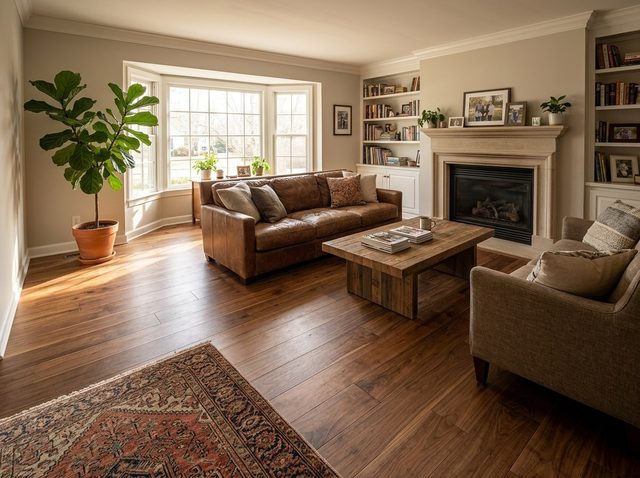
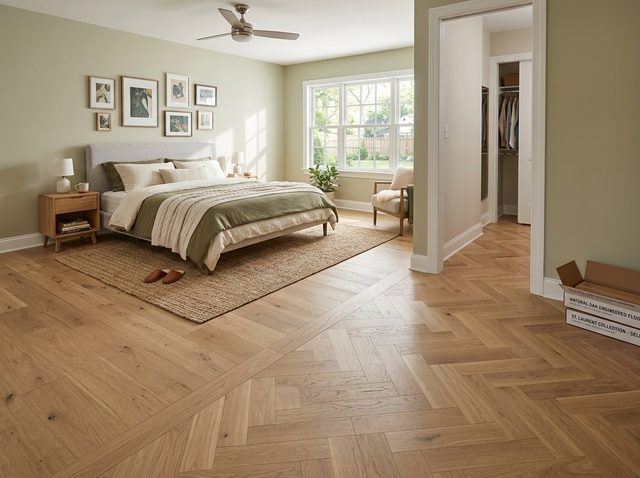
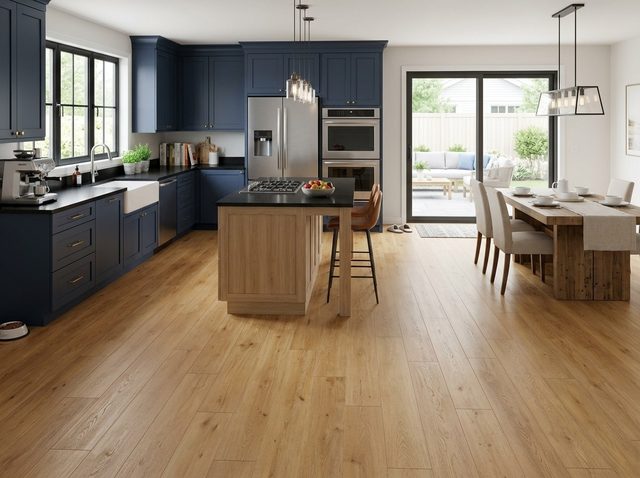
Flooring Installation in Concord — FAQ
What does new flooring cost installed in Concord?
Installed with materials: LVP and laminate run $4–8 per sq ft, engineered hardwood $8–14, solid hardwood $12–18. Add demo of existing floors, subfloor or slab prep, and stairs as separate lines — we show each in the quote so you can compare bids apples-to-apples. Most whole-home LVP projects in typical Concord ranches land comfortably in the low five figures.
How do I know if my Concord house is on a slab?
Quick tells: no crawlspace vents in the foundation, floors that feel dead-solid underfoot, and heating registers in the ceiling rather than the floor. Early-1950s Concord homes are usually raised; 1960s-and-later tracts are usually slab. It matters because slabs need moisture testing and glue-down or floating products, while raised floors accept nail-down hardwood. We confirm it in minutes at the free measure.
Could my old vinyl flooring contain asbestos?
If your home predates 1980 — most of Concord's housing does — older vinyl tile, sheet flooring, and black mastic adhesives can contain asbestos. Undisturbed, they are not dangerous; demolition without testing is where problems start. We sample suspect layers, send them to a lab, and bring in licensed abatement if results come back positive. It is a standard step, priced transparently, never a scare tactic.
Which floor is best for a Concord rental property?
LVP, in almost every case. At $4–8 per sq ft installed it is waterproof, scratch-resistant, tolerant of tenant turnover, and individual planks can be replaced after damage. It handles Concord's summer heat without the movement issues wood can develop in poorly climate-controlled units. We do volume turnover work for local landlords, often completing an occupied-unit-sized job between tenants in two to three days.
Can you match or extend the original oak in my older home?
Usually yes. Red oak strip in Concord's early homes is a standard dimension that is still milled today; we weave new boards into the old field, then sand and finish everything as one floor so the patch disappears. When a previous owner's repairs used mismatched species or the boards are sanded too thin, we will show you why replacement beats another refinish.
Do you handle furniture and appliance moving during installs?
Yes. We phase whole-home installs so furniture shifts room to room with the work — our crew moves it, protects it, and puts it back. Appliances get disconnected and reconnected, including refrigerator water lines. Most Concord families live in the house through the entire project; a typical single-story install runs about a week including prep, a bit longer with demo of glued layers.